See What I Say?
January 4–15, 2023 — Macleay Valley Community Art Gallery, Gladstone NSW
Exhibited with Cracking Ice
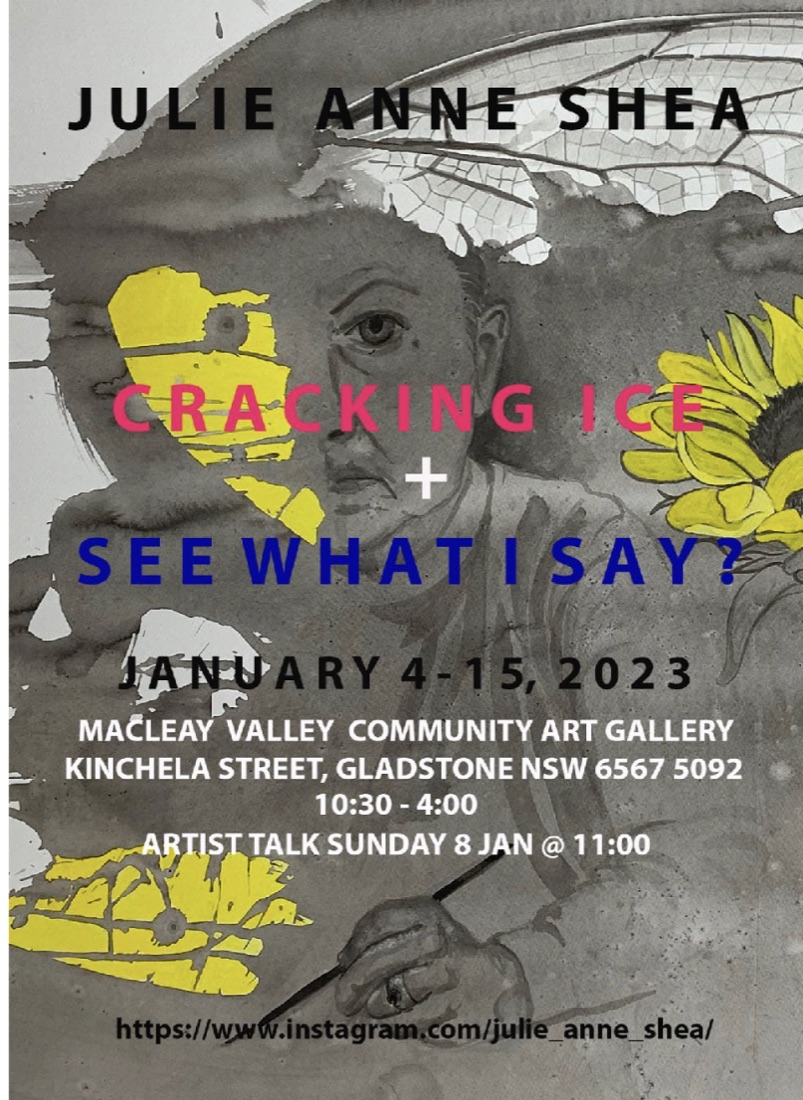
Apophenia is the result of the human tendency to find meaningful patterns in random stimuli. This includes pattern making in sound such as hearing voices in birdsong or white noise, making sense from randomised words, and finding images in visual chaos, which is called pareidolia. Examples of pareidolia include finding animal shapes in clouds, or faces in the bark of trees. The amount of pareidolia a person experiences varies depending on the personality traits of sex differences, developmental factors, neuro developmental conditions, belief in the paranormal, and individual creativity. This is consistent with psychological explanations of visual perception and the amount of influence that past experience and stored information has on it: “we actively construct our own perception of reality.”
The process itself is well recorded in history — constellations were, and still are, named after joining the dots of stars to create objects such as the Big Dipper and animals like Leo the lion. This quality has been used by artists throughout history, the most famous being Leonardo da Vinci who wrote in his notebook: ‘If you look upon an old wall covered with dirt, or the odd appearance of some streaked stones, you may discover several things like landscapes, battles, clouds, uncommon attitudes, humorous faces, draperies, etc. Out of this confused mass of objects, the mind will be furnished with an abundance of designs and subjects perfectly new.’ William Kentridge explores a similar concept of creating imagery in (Repeat) From the Beginning/Da Capo where a recognisable image in a mass of fragments of paper becomes visible as a shadow produced from only one point of view. Making images from inkblots, called Klecksography, was a popular childhood game for psychoanalyst Rorschach. The well-known and controversial Rorschach Inkblot method of psychoanalysis has used this technique as a tool to study personality and emotion since the 1890’s.
Confirmation bias is “the tendency to search for, interpret, favour, and recall information in a way that confirms or supports one’s prior beliefs or values.” People tend to ignore contrary evidence if it fails to support their own beliefs. This bias can combine with pareidolia (as evidence) to skew perceptions, reinforce prejudices, and support conspiracy theories. If we can become more aware of how our perception works we may be able to avoid these dangerous and contagious perceptions.
The Fox, The Chief and the Hunter
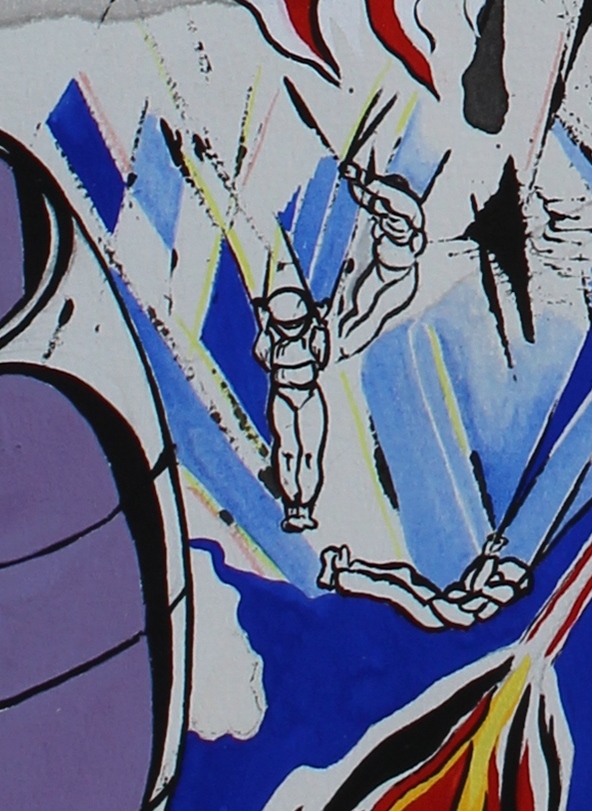
While researching the game “Scissors, Paper, Rock” for a group exhibition in 2015, I found the Japanese original Kitsune-ken — The Fox, The Chief and the Hunter. I began by making ink prints using scissors, rocks and water on a paper ground and then started to draw out the imagery from the chaotic stains. I noticed how easy it was to find some of the imagery I needed — there was an abundance of foxes in the varying tones of all the background washes. I was also astonished at how precisely some of the internet and printed reference images I found fitted into these backgrounds. For example an image I found of a traditional Japanese man fitted neatly into the varying tones of one background wash. Other images from my memory popped from each background such as Lichtenstein’s “Blam”. Images I found for reference such as traditional Japanese patterns appeared to have already been “started” by chance in some of the underlying washes. I enhanced the apparitions using watercolour, ink and gouache and a little collage.
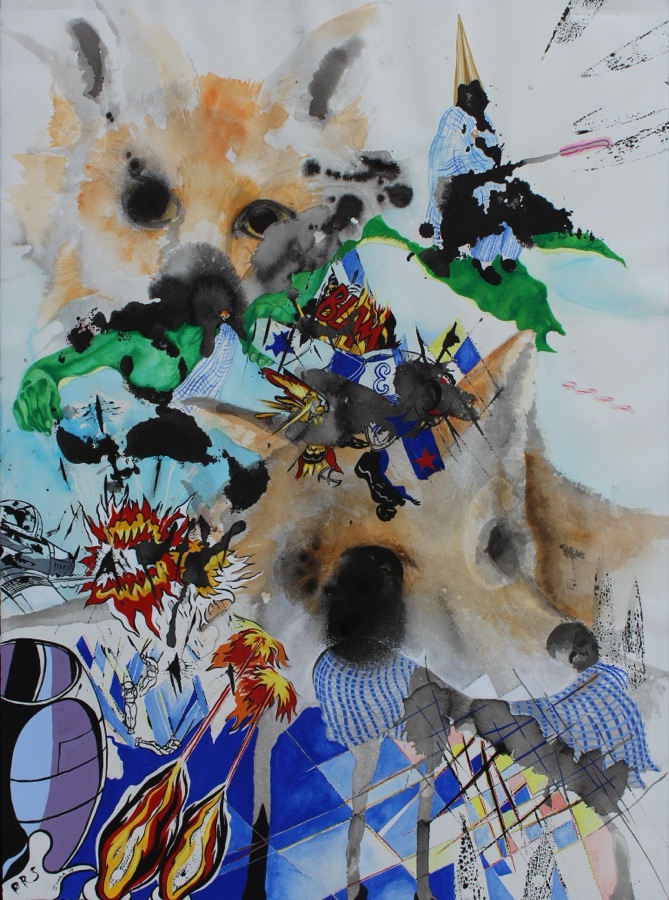
57 × 76 cm
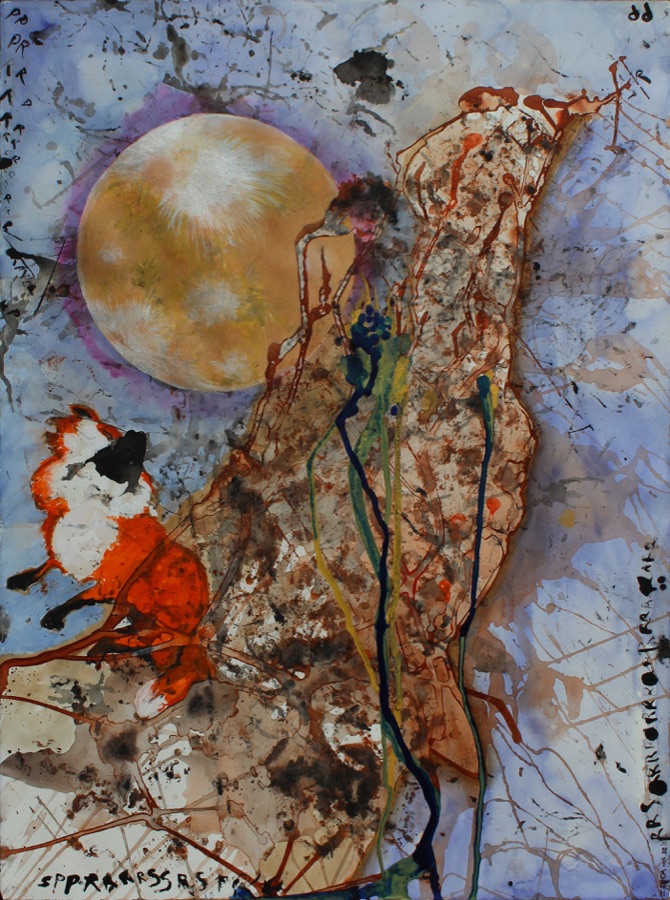
57 × 76 cm
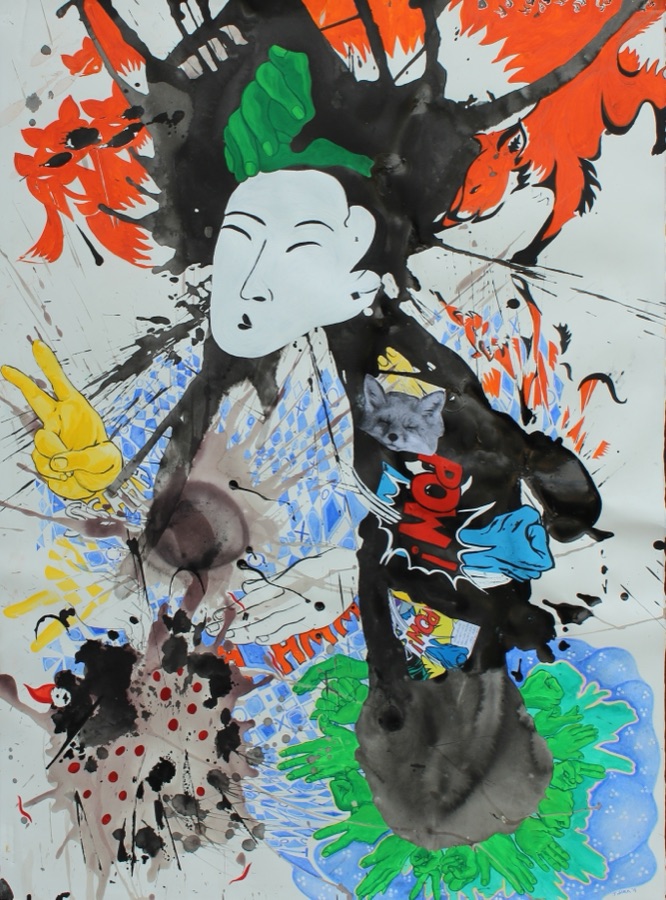
57 × 76 cm
White Lion
I later tested this observation by squashing ink between two sheets of paper, first deciding to see a white lion in the ensuing stain. After a couple of days straining to find the lion and at the point of considering the experiment a failure, I began to roll back the top sheet of paper and suddenly the paws, legs, body and head of the white lion revealed itself.
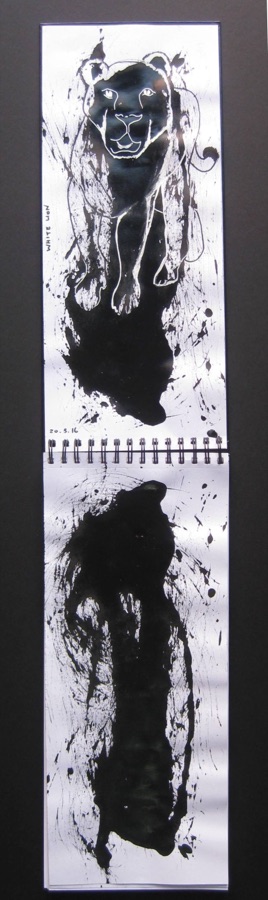
ink and liquid paper on diary pages, 43 × 18 × 2 cm
Words Beneath
I experimented, choosing random phrases and words which I stencilled in masking fluid onto a paper background. I splashed ink across the surface then removed the mask. All of the words prompted images in the ink stains. Other interesting details were revealed in alternative readings of the texts.
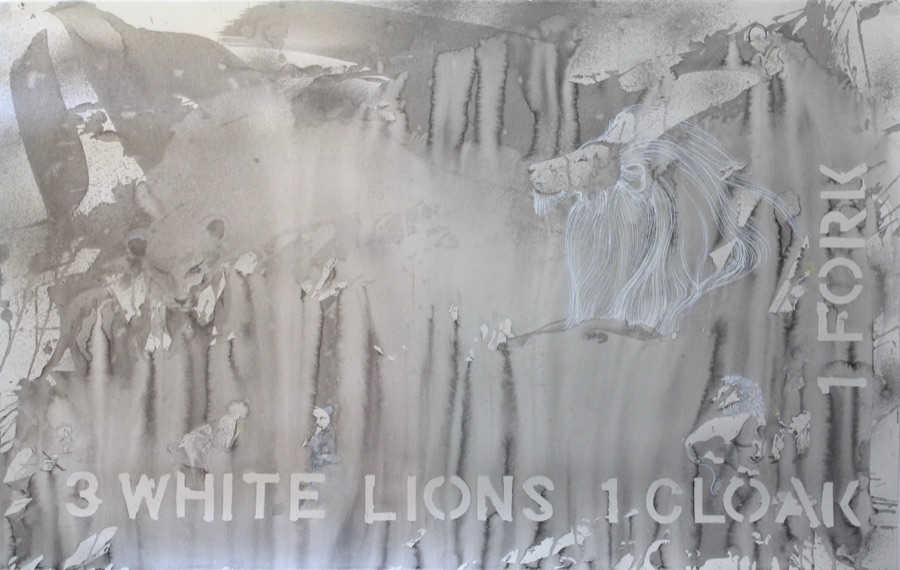
ink on paper, 70 × 100 cm
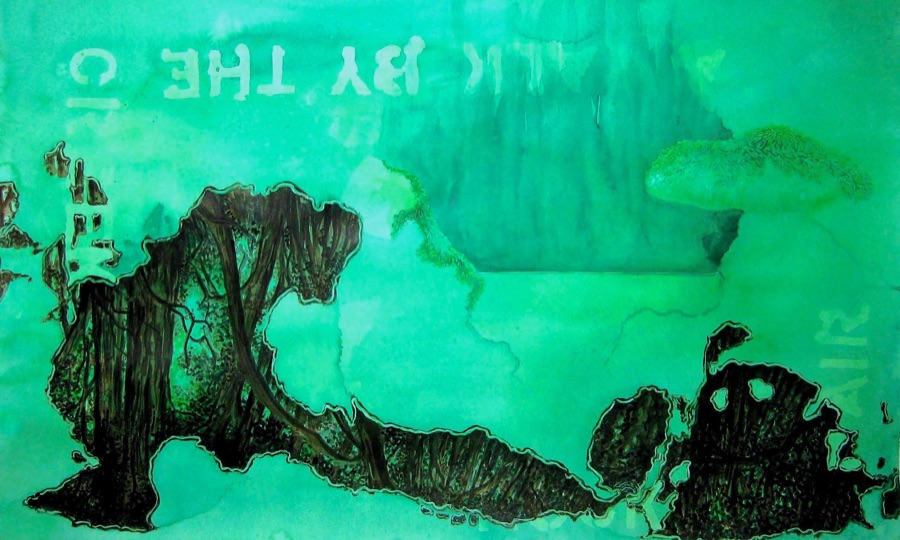
ink & gouache, 70 × 100 cm
Surrender: Three Backgrounds
I asked three young art students to make random marks in white on a black paper background, and then asked nine friends, giving no explanation, to supply three words each. These words I systematically grouped in sets of three according to time of arrival and their order in the list. The images suggested were then found and drawn onto the chaotic backgrounds.
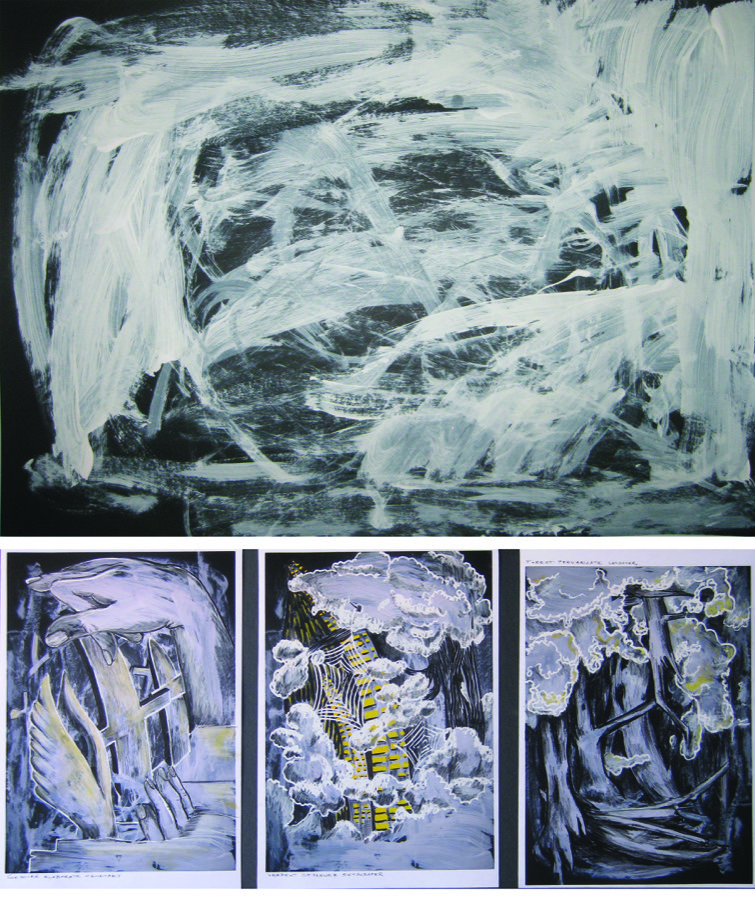
acrylic on paper, 50 × 70 cm; set 22 × 95 cm
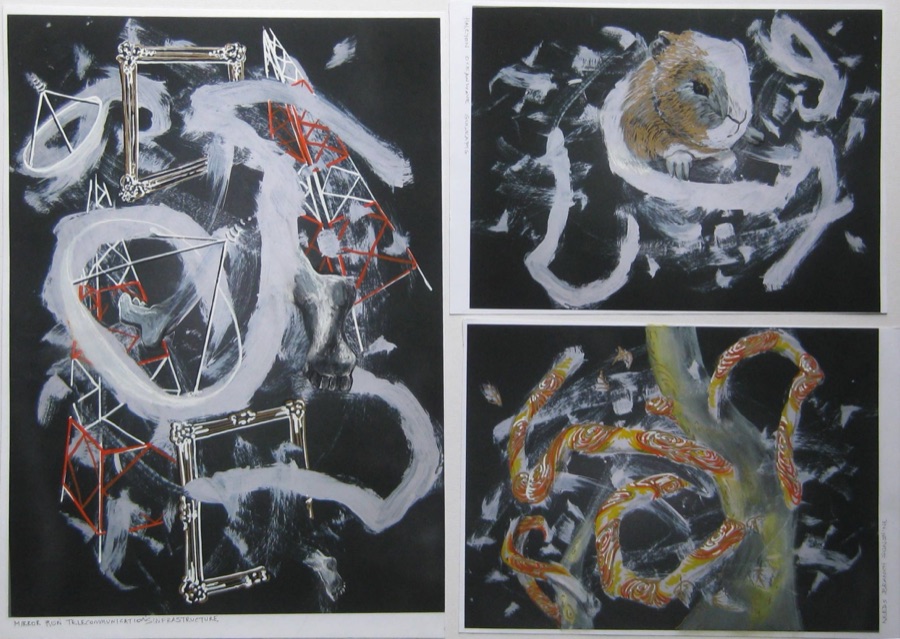
acrylic on paper, 50 × 70 cm
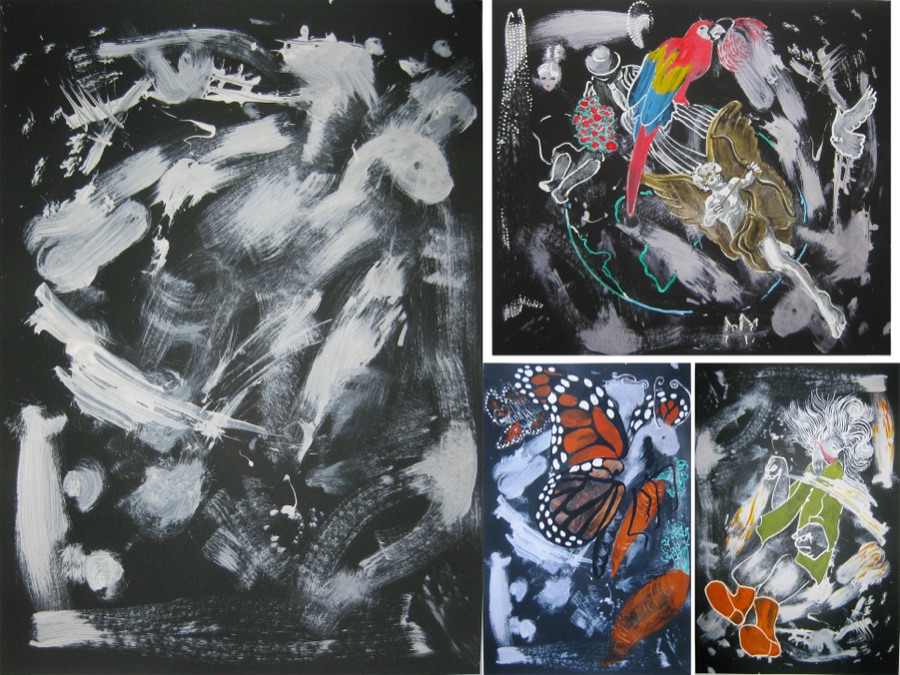
acrylic on paper, 50 × 70 cm
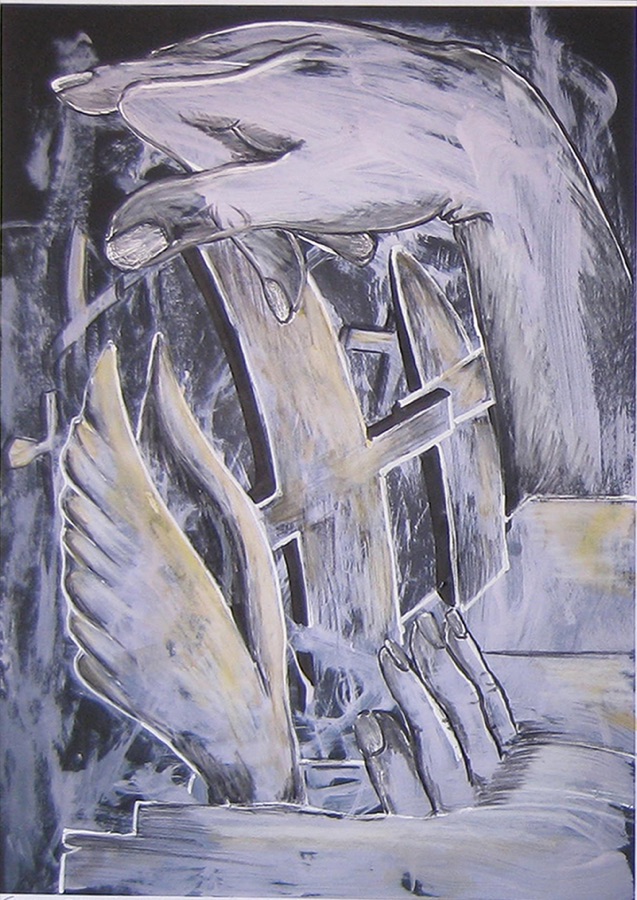
21 × 30 cm
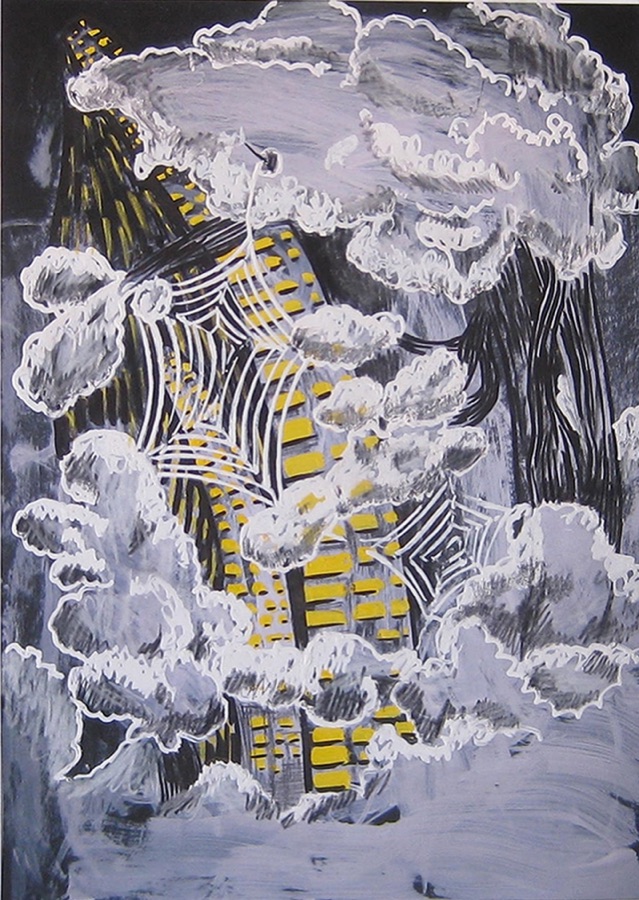
21 × 30 cm
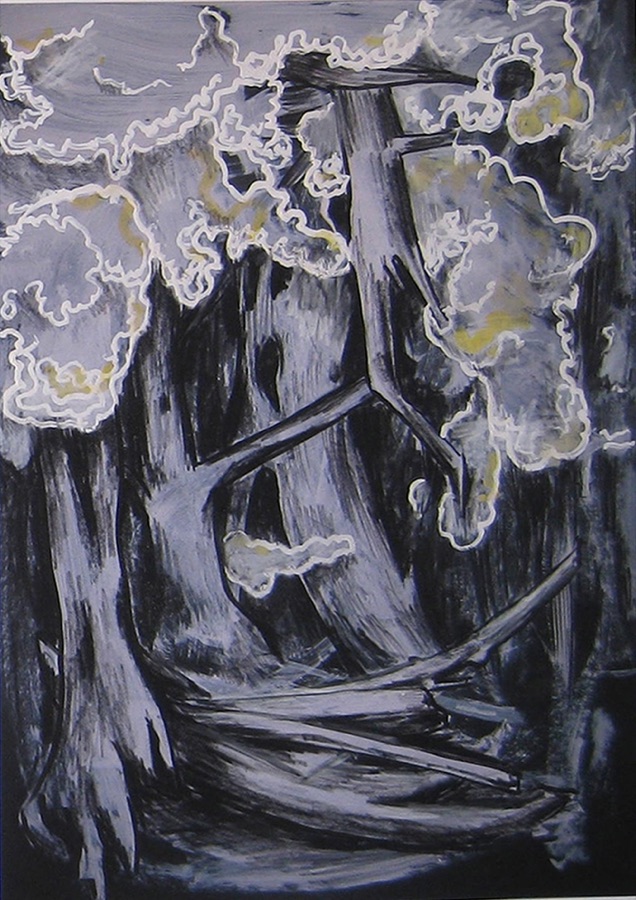
21 × 30 cm
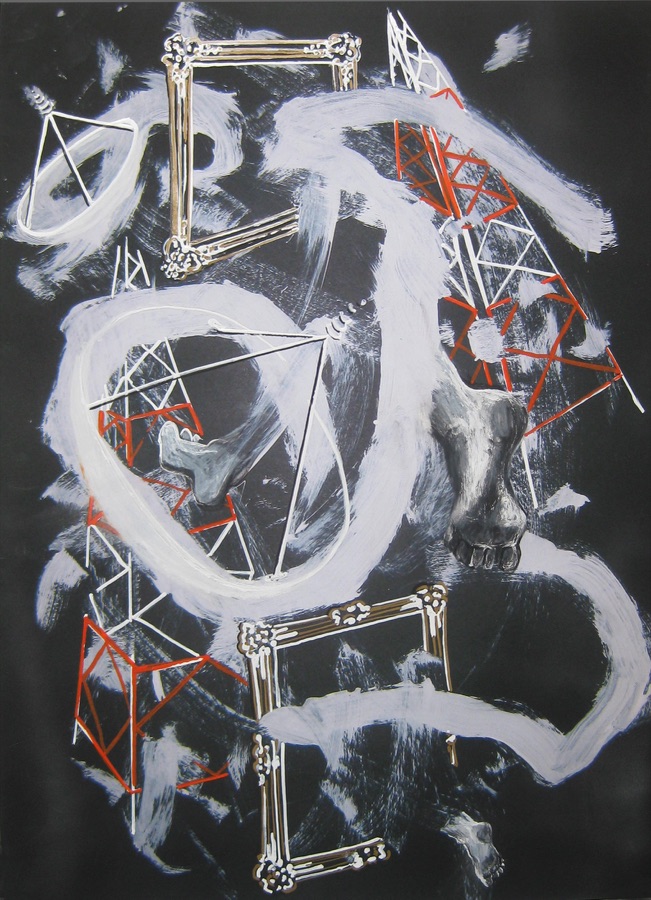
42 × 30 cm
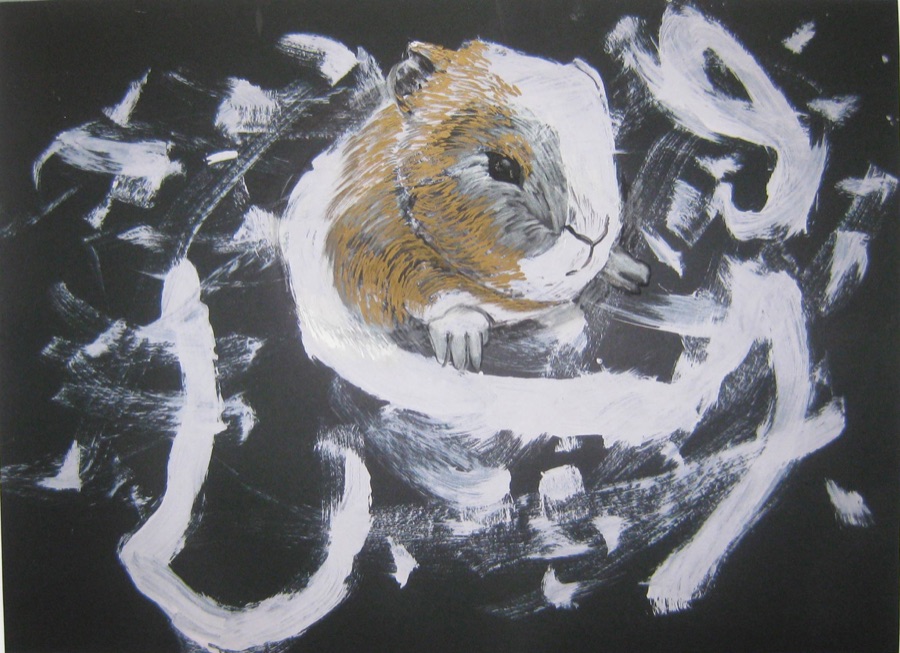
21 × 30 cm
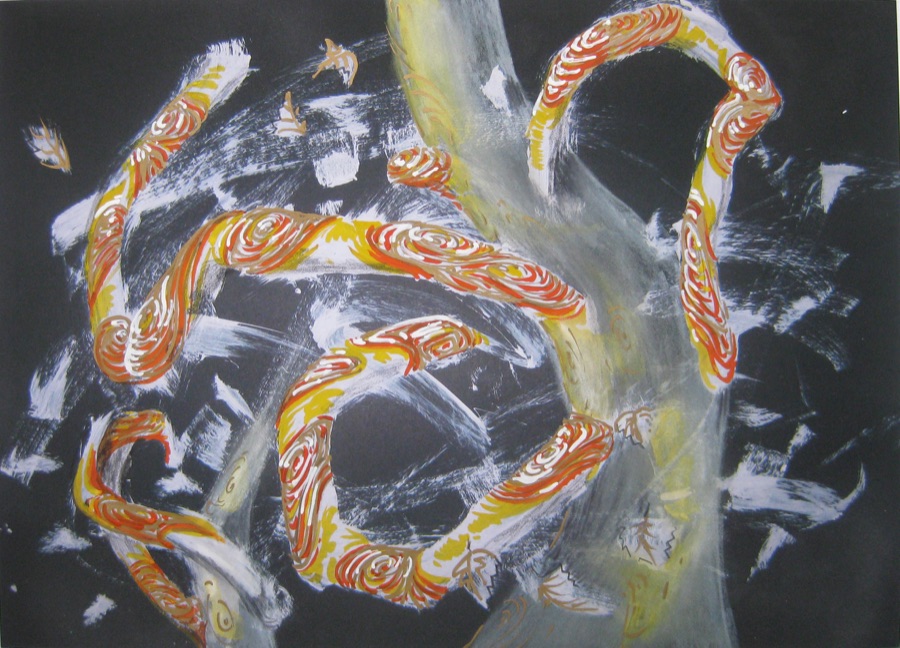
21 × 30 cm
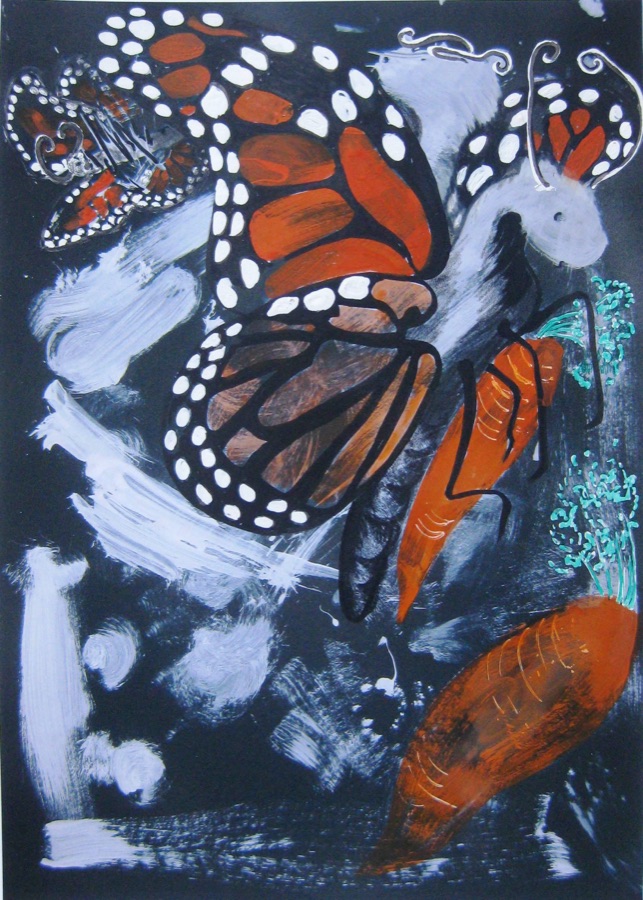
30 × 21 cm
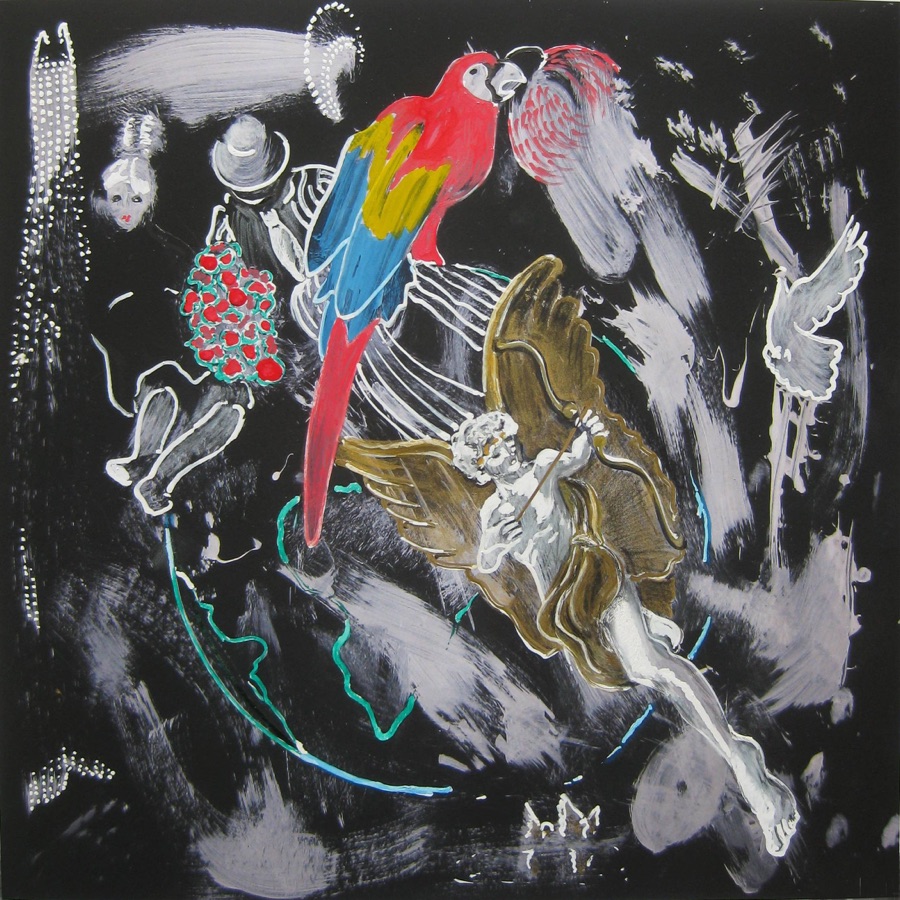
30 × 30 cm
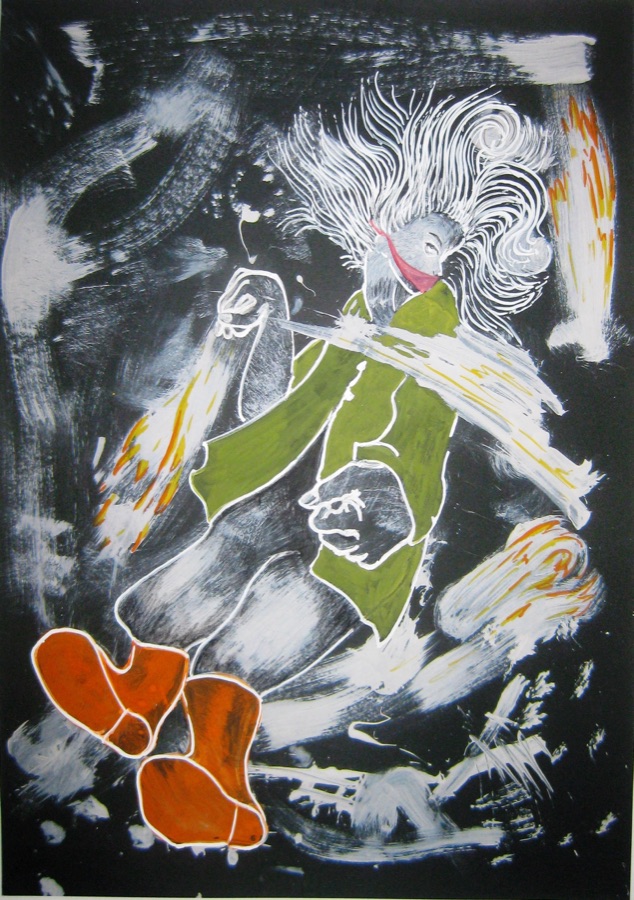
42 × 30 cm
Santa and the Reindeer, Cats in Surgery and Mickey San
Spontaneous fantastical pareidolic images appear, bubbling through from the subconscious onto the splashed ink.
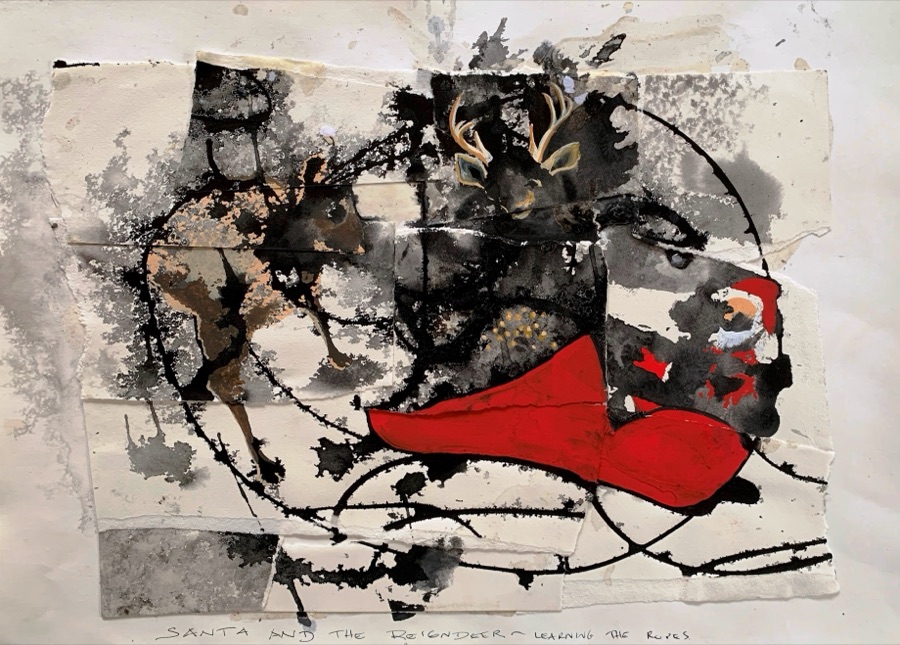
ink gouache collage on paper, 40 × 50 cm
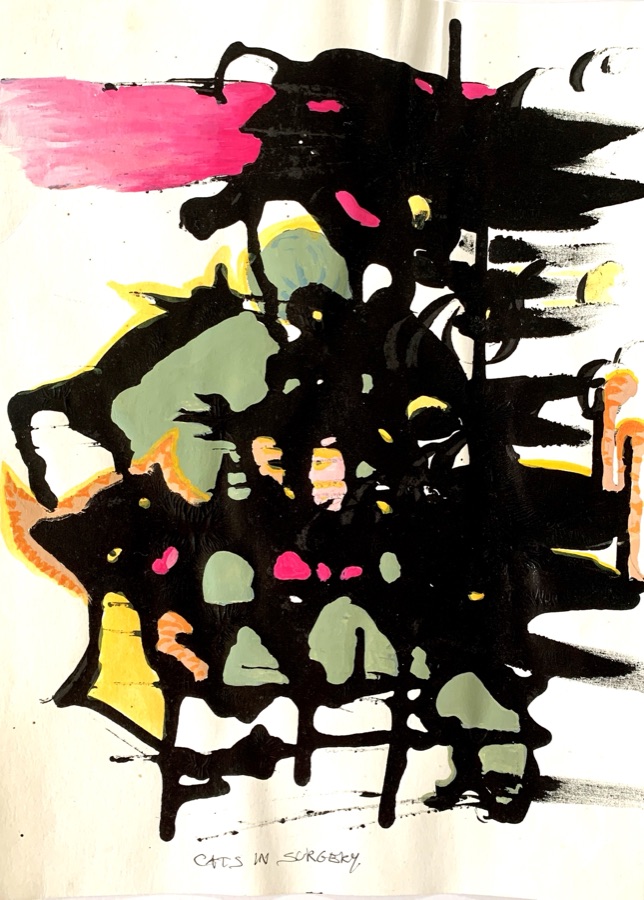
ink and gouache on paper, 32 × 23 cm
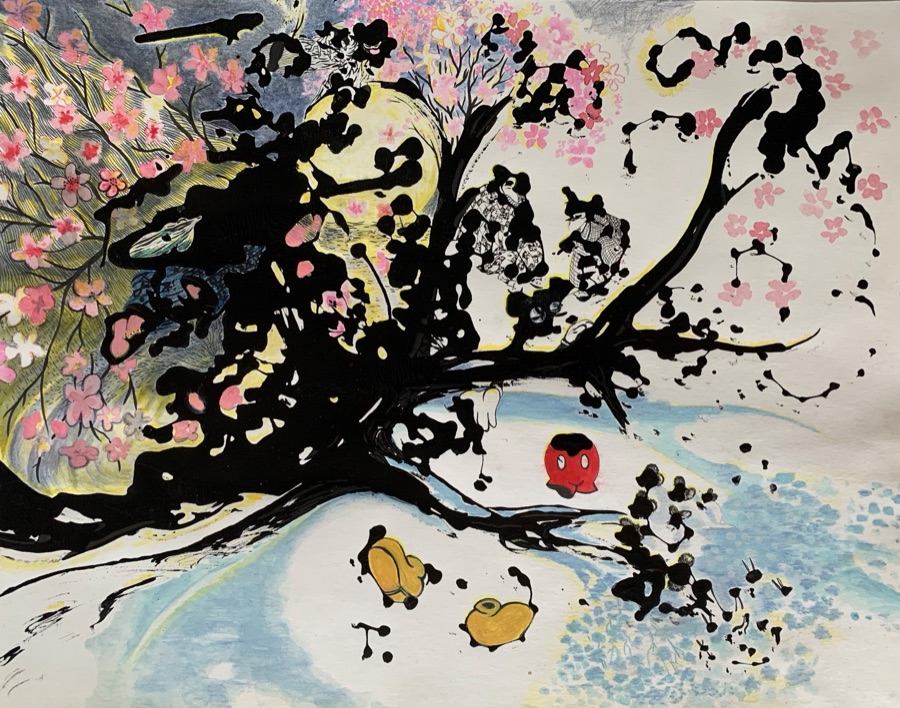
ink and gouache on paper, 35 × 45 cm
Japanizi
A visit to Japan in 2018 increased my ability to relate tonal backgrounds to my documented and remembered store of imagery around the experience. Like Japanese Hatsuboku ink-splash drawing, a space is created to connect with “divine inspiration” to form imagery in the ink stained paper.
After immersing himself in legends of valiant knights, Don Quixote was certain that windmills he saw were giants for him to overcome. “What does the windmill represent in Don Quixote? The windmill represents imaginary enemies. More broadly, it represents our potential for misguided fights that we romanticize or idealize in our minds.”
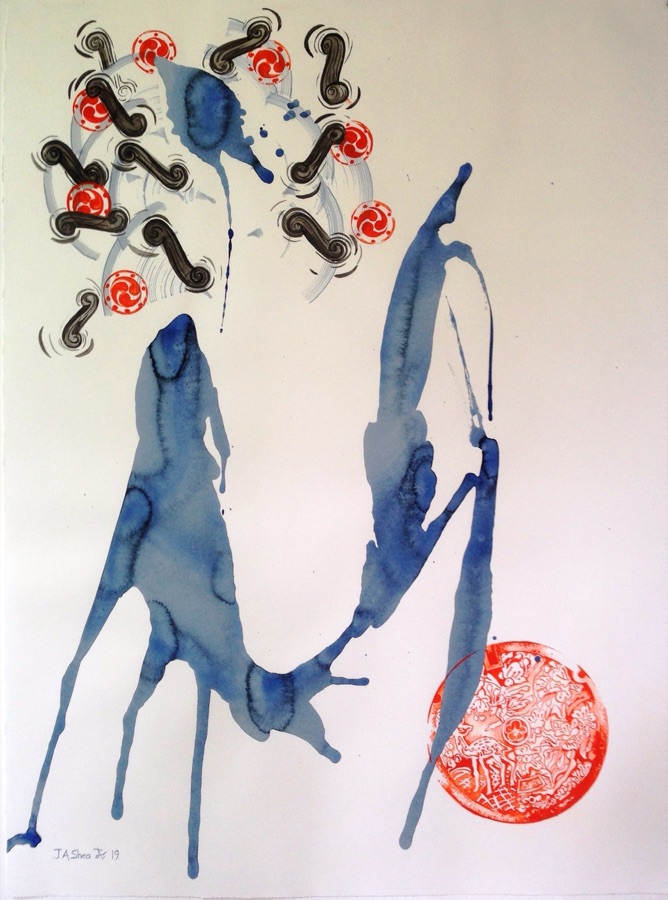
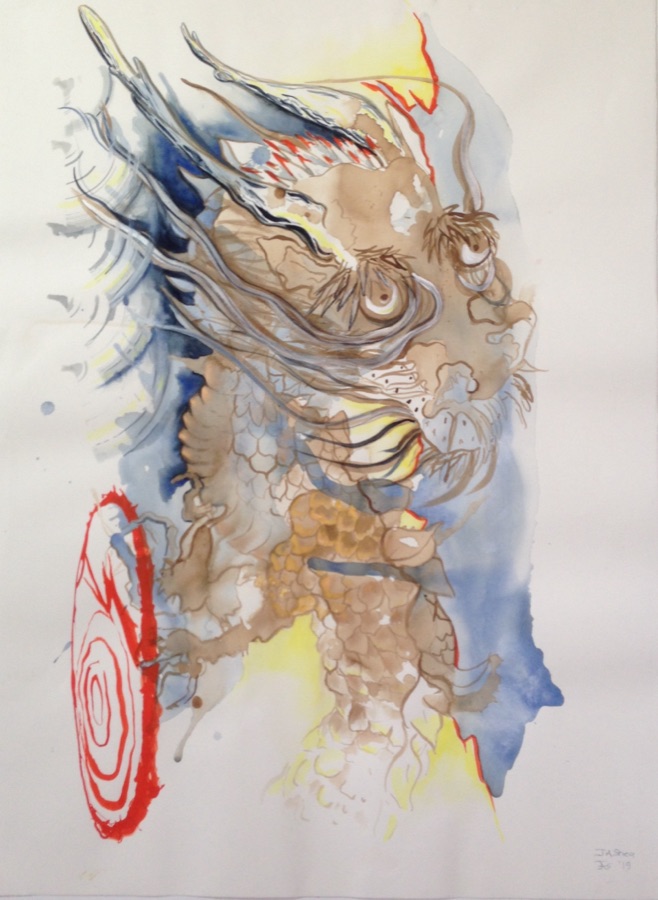
ink on paper, 76 × 56 cm
ink on paper, 76 × 56 cm
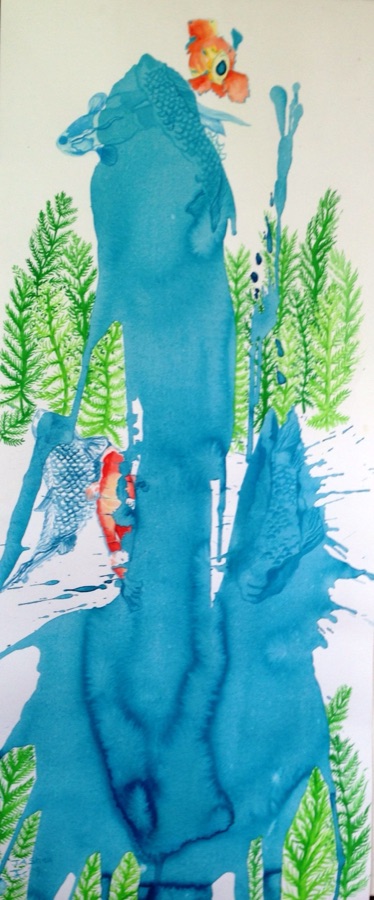
ink and gouache on paper, 101 × 35 cm
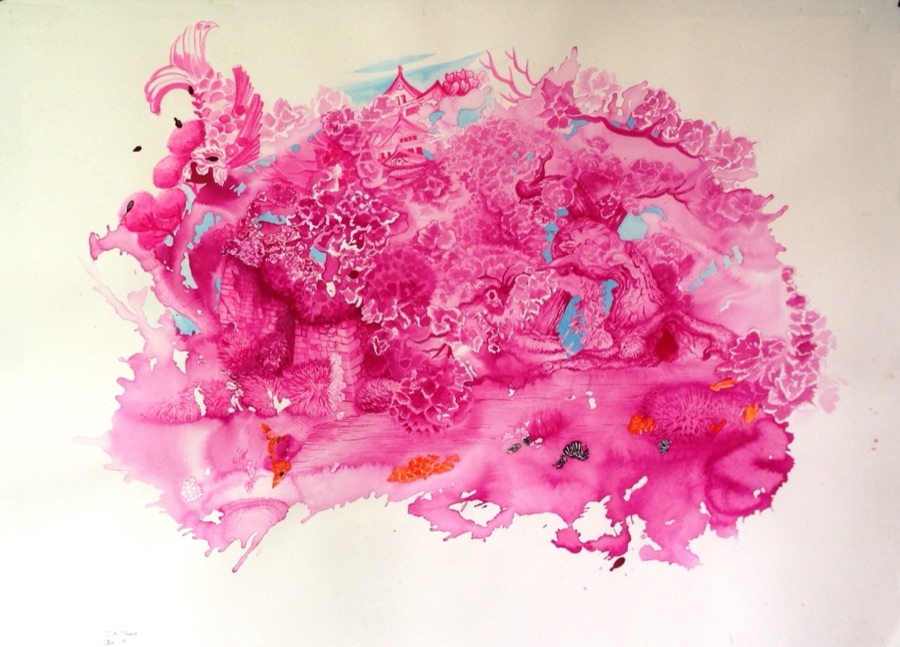
ink on paper, 56 × 76 cm
Retreat: Becoming the Forest
Retreat: Becoming the Forest (2019/20) combines body forms with reflected landscape in forest creek pools, and references Animism. Visual camouflage blurs bodies in the landscape — the obvious becomes hidden. See the full Retreat: Becoming the Forest project.
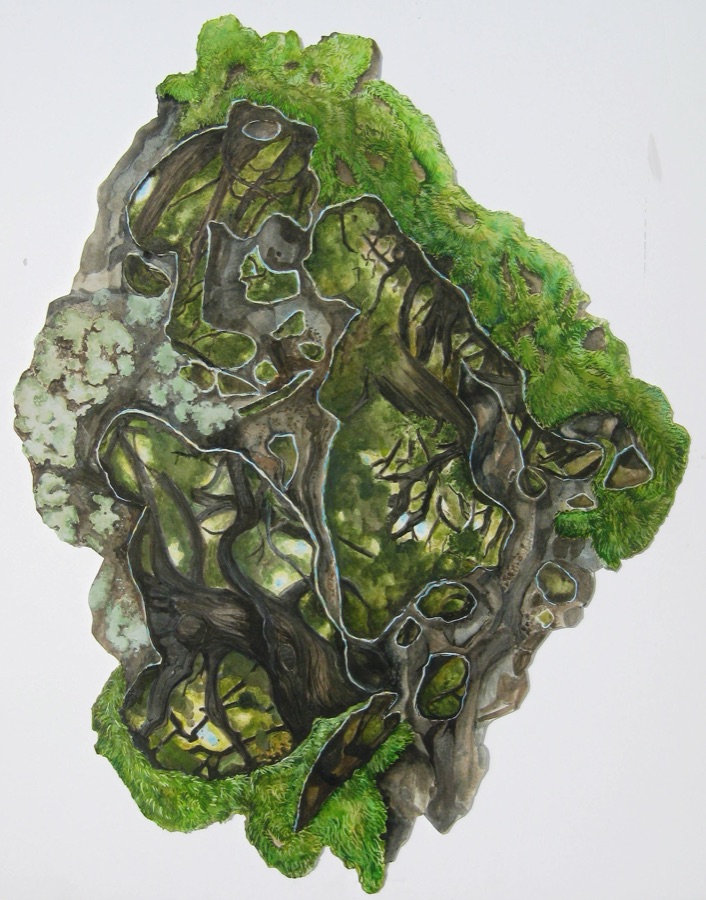
ink & gouache on paper, 90 × 70 cm
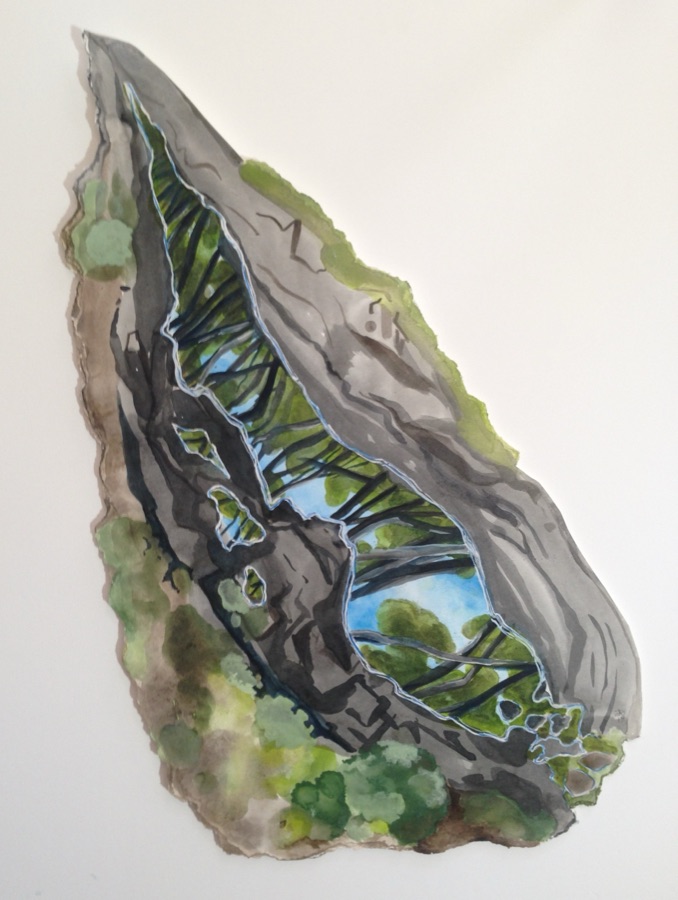
ink & gouache on paper, 72 × 43 cm
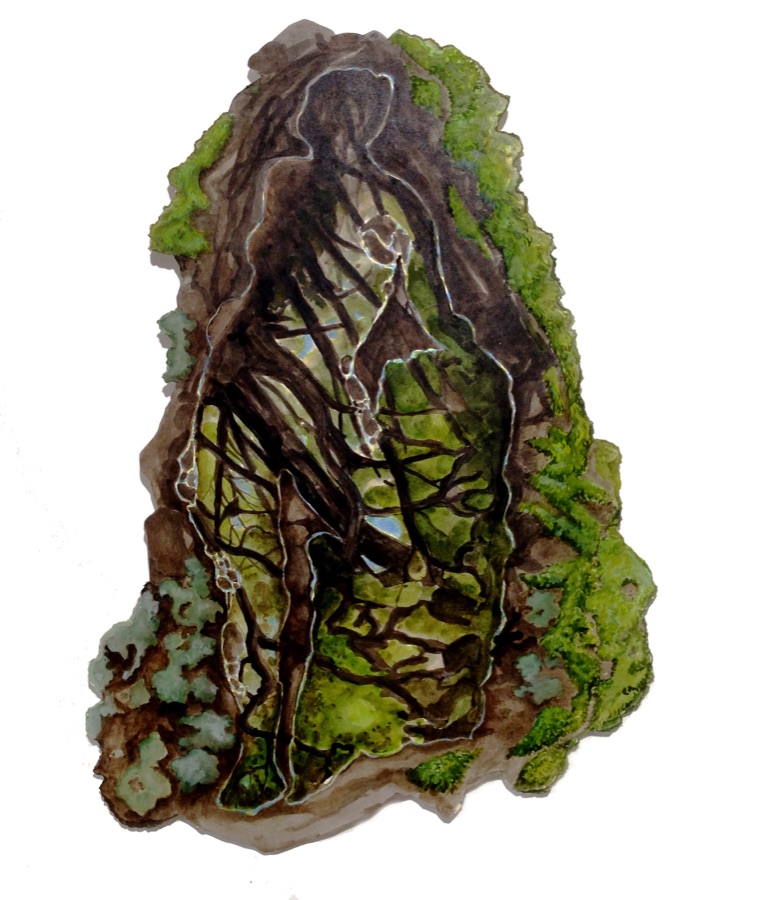
ink & gouache on paper, 70 × 49 cm
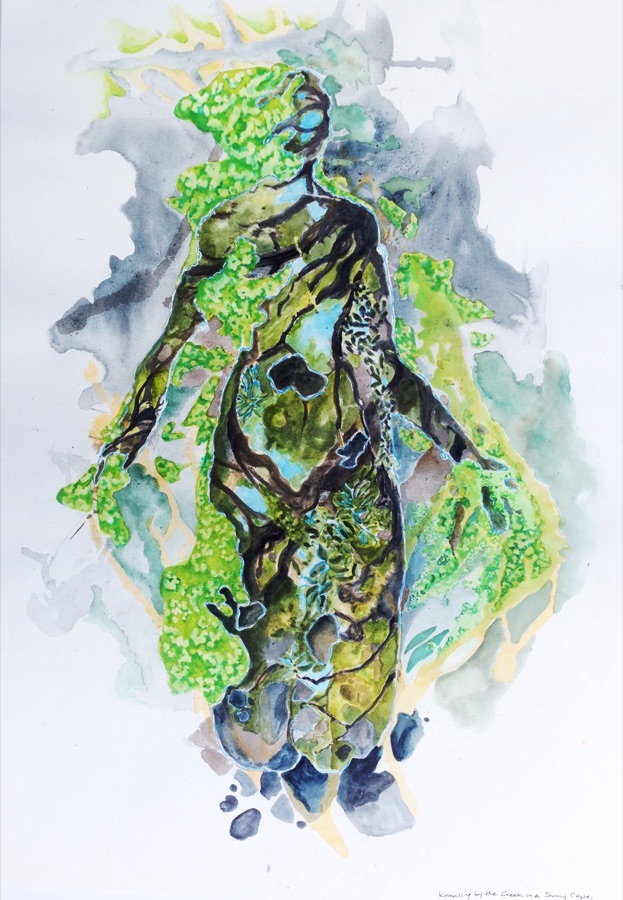
ink & gouache on paper, 76 × 56 cm
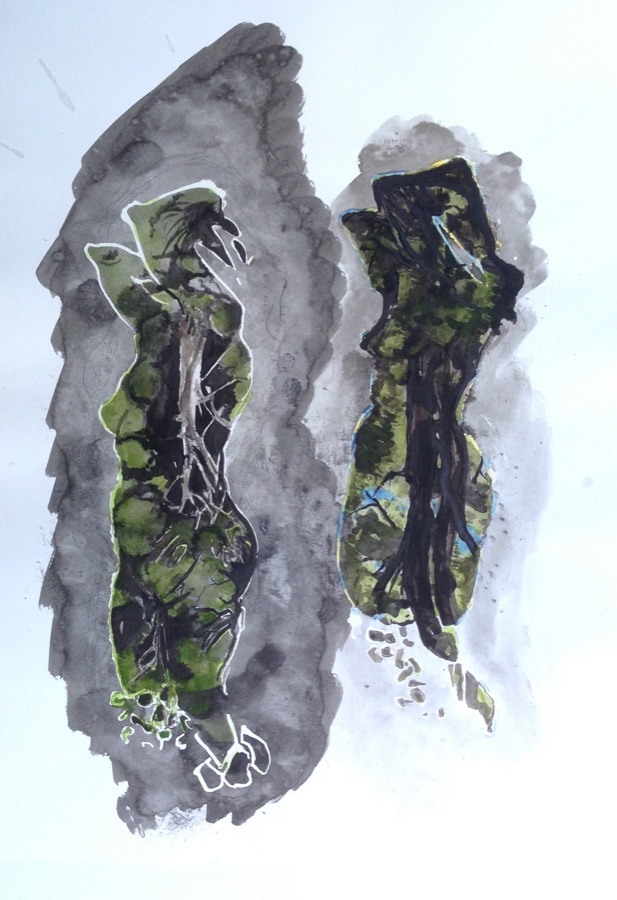
ink & gouache on paper
Giraffosaurs in the Landscape (Elephant) and To Those That Went Over the Cliff
Spontaneously perceived metaphors of contemporary (2020) social, political and environmental catastrophes embedded in my sight.
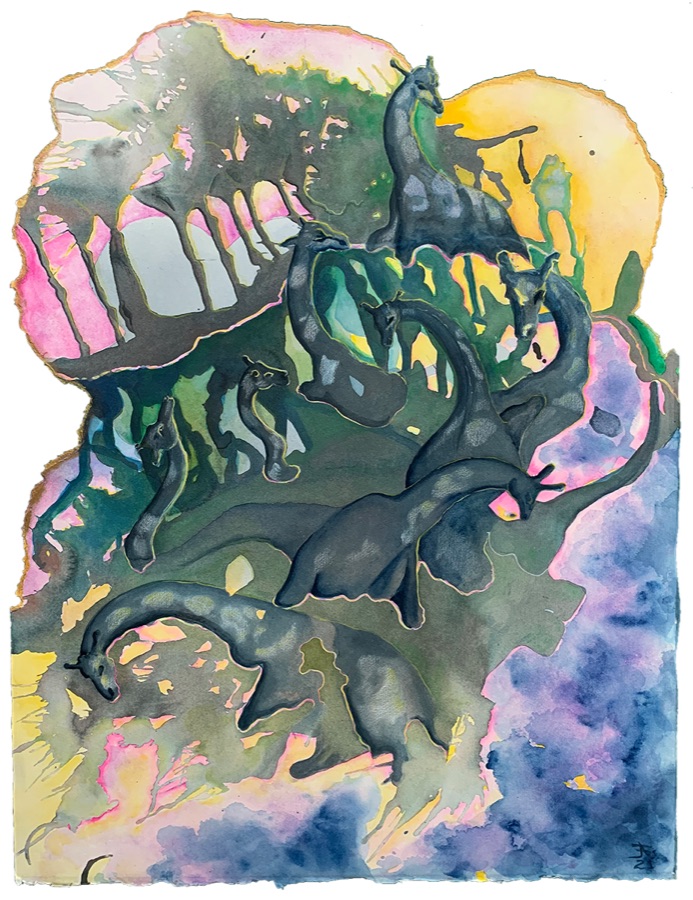
ink & gouache on paper, 67 × 52 cm
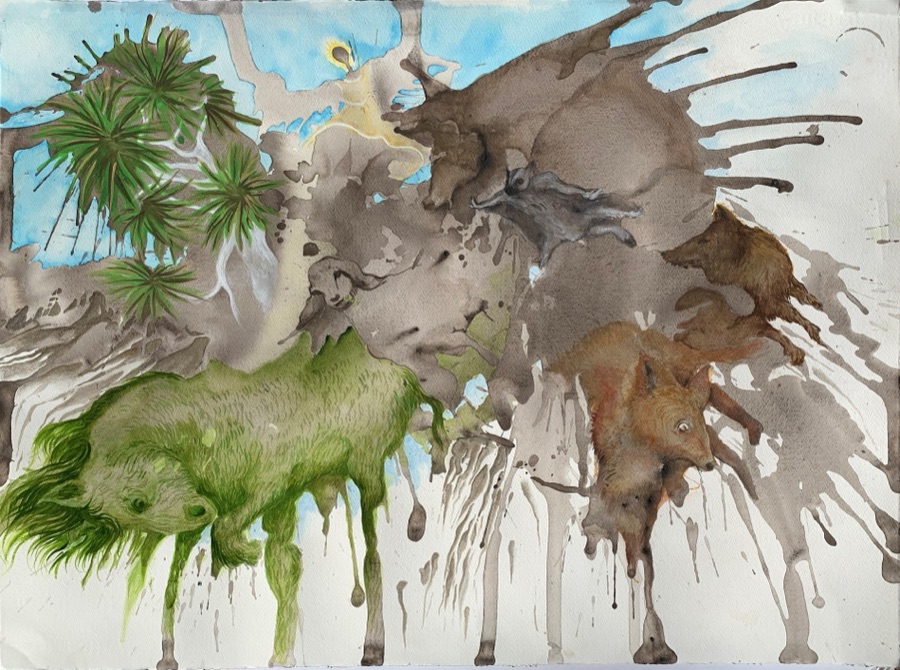
ink & gouache on paper, 57 × 76 cm
This exhibition began in Room 1 with Cracking Ice.